



Inter-individual differences
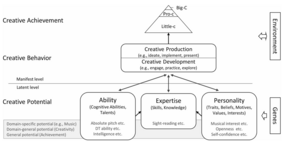
How do laypeople differ from professional artists? People differ in creative potential and creative behavior. Creative potential includes those personality traits (e.g. openness), cognitive abilities (e.g. divergent thinking and intelligence) and domain-specific expertise that predict creative behavior. Creative behavior, in turn, includes observable creative activities and performances. We investigate which traits are relevant for creative potential and how their interplay predicts creative behavior in different domains.
Selected further reading:
- Benedek, M. (2024). On the relationship between creative potential and creative achievement: Challenges and future directions. Learning and Individual Differences, 110, 102424. https://doi.org/10.1016/j.lindif.2024.102424
- Benedek, M., Bruckdorfer, R., & Jauk, E. (2020). Motives for creativity: Exploring the what and why of everyday creativity. Journal of Creative Behavior, 54(3), 610-625. https://doi.org/10.1002/jocb.396
- Benedek, M., Calisgan, G. Y. & Saretzki, J. (2024). How do creative professionals stand out? Comparing the creative potential of musicians and actors to non-artists. Personality And Individual Differences, 236, 112993.
- Jauk, E., Benedek, M., & Neubauer, A. C. (2014). The road to creative achievement: A latent variable model of ability and personality predictors. European Journal of Personality, 28, 95-105. https://doi.org/10.1002/per.1941

Self-Assessment and Self-Perception
We are not only interested in understanding which traits and processes are relevant for creativity. We also examine how accurately individuals can assess themselves. Why do people believe they are creative? What ideas and concepts do they have about their own creativity, and to what extent is creativity a meaningful part of their identity? Self-perceptions have a major influence on whether and what kind of creative behavior is shown. We are working to uncover these nuances and develop the corresponding measures.
Selected reading:
- Benedek, M., Bruckdorfer, R., & Jauk, E. (2020). Motives for creativity: Exploring the what and why of everyday creativity. Journal of Creative Behavior, 54(3), 610-625. https://doi.org/10.1002/jocb.396
- Benedek, M., Ceh, S. M., & Saretzki, J. (2026). Why are most people more creative than others? Exploring the better-than-average effect in creativity. Personality and Individual Differences, 264, 114047. https://doi.org/10.1016/j.paid.2026.114047
- Benedek, M., Saretzki, J. & Lebuda, I. (2025). Why do you think you are creative? An analysis of sources and correlates of creative self-concept judgements. Thinking Skills And Creativity, 57, 101813. https://doi.org/10.1016/j.tsc.2025.101813
- Wojtycka, L., Lebuda, I., Saretzki, J., & Benedek, M. (2026). Building the Creative Self: The Sources of Creative Self-Concept Scale. Thinking Skills and Creativity, 102157. https://doi.org/10.1016/j.tsc.2026.102157